
Category: Yacht Operations

Maintenance planning, readiness and day-to-day operational decisions on board.

  • Yacht inspection: turning onboard findings into an action plan

    Yacht inspection: turning onboard findings into an action plan

    A blocked drain, a deteriorating seat support, a fitting that no longer closes properly: small onboard defects deserve more than a loose repair list. During targeted visits for owners and yacht management teams, I photograph findings, identify what still needs checking and turn observations into a prioritised work report.

    This anonymised example comes from a real visit. The report covered nine work packages, from essential functions to guest comfort. The three extracts below show observations and recommendations, not completed repairs.

    Why carry out a targeted onboard inspection?

    It complements the crew’s daily monitoring by bringing scattered issues into one clear view. What affects the yacht’s use? What may worsen if left unattended? What can be scheduled? The owner and management then have a practical document for decisions, quotations and follow-up.

    Priorities remain provisional until access, equipment references and compatible parts have been confirmed. A useful report separates what was observed, what is proposed and what still needs verification.

    Example 1: a blocked locker drain

    Water was not draining properly from a port-side locker. The visible mark alone does not define the repair. The drain route, hose, fittings and outlet must be checked to find the obstruction. After addressing the cause, a documented flow test should confirm the result.
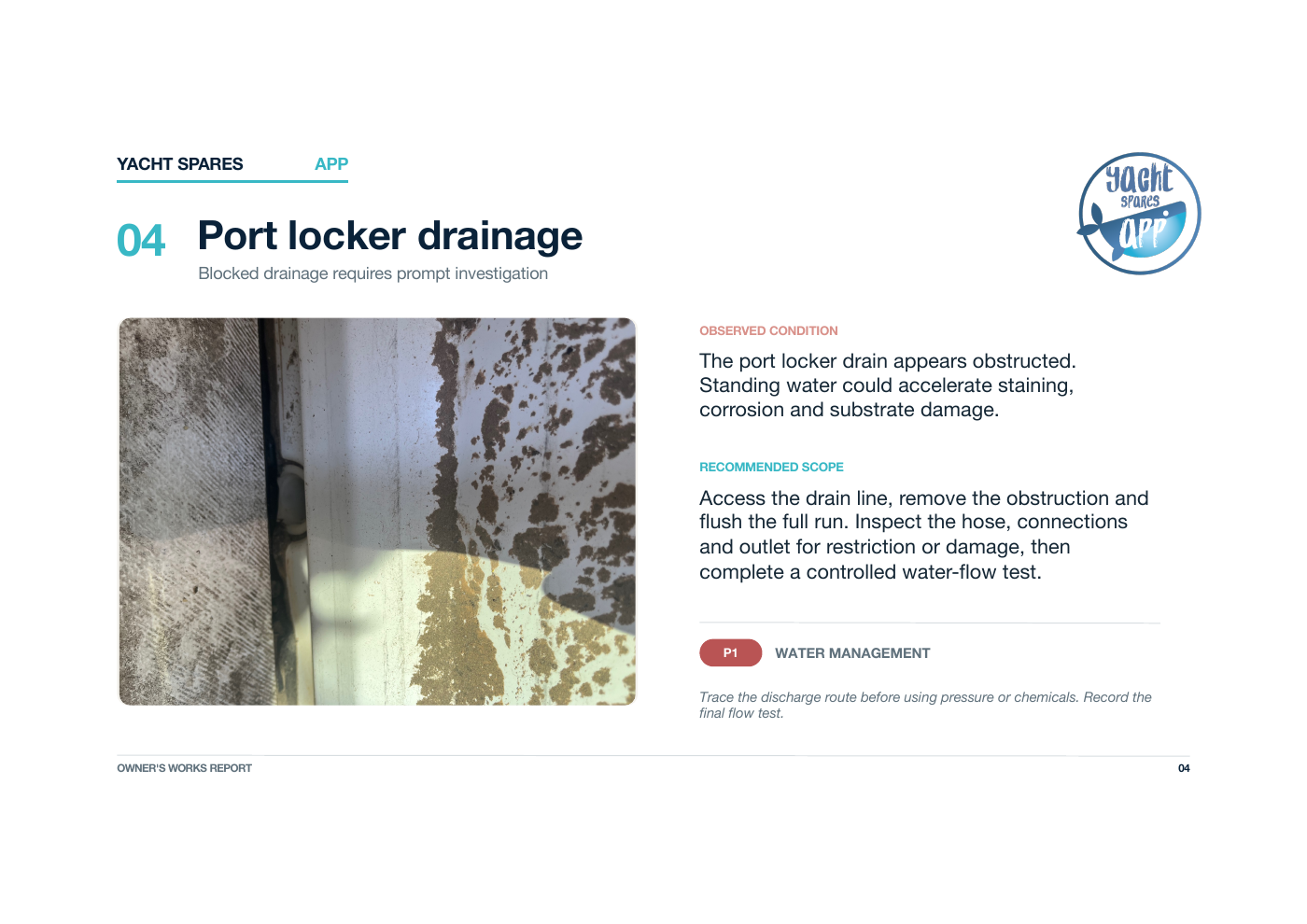
    Inspection report extract showing a blocked port-side locker drain
    Report extract: photographic finding, proposed intervention and drainage check.

    Example 2: repairing a seat and its support

    A torn cover can conceal a deeper problem. Here, moisture had also damaged the wooden support. Replacing the upholstery alone could leave the cause untouched. The proposed scope includes finding the water ingress, removing the seat, making a protected marine-grade support and restoring the upholstery after approval of the material and colour.
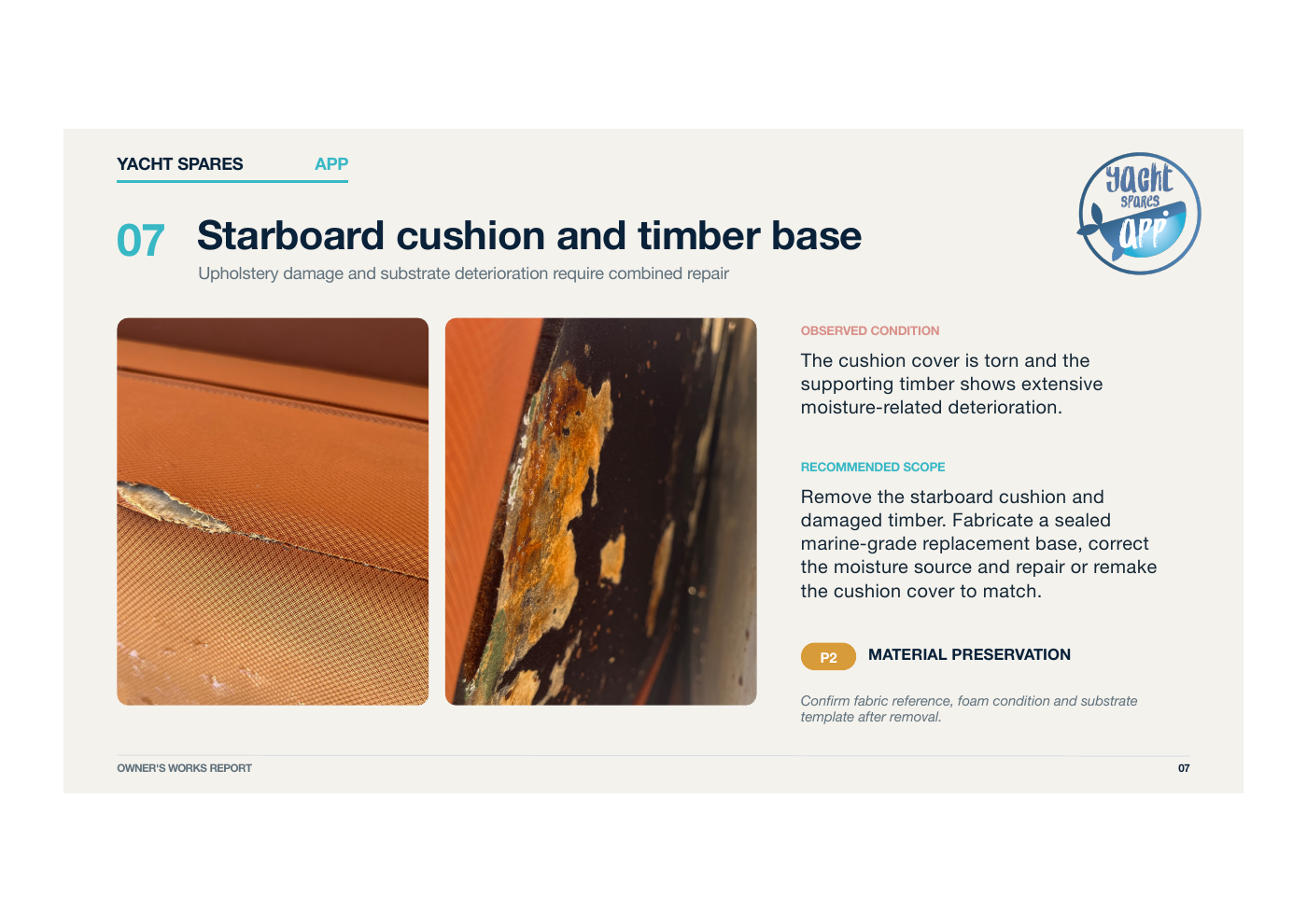
    Inspection report extract showing torn seating and damaged timber support
    The condition of both the seat and its support is recorded before the repair is defined.

    From finding to acceptance

    The report goes beyond photographs and proposes a sequence that reduces ordering mistakes and rework:

    • Confirm: measure, identify models, check access and agree the owner’s choices.
    • Source: identify compatible parts and prepare the work package.
    • Execute: protect adjacent finishes, carry out the work and document what is found after dismantling.
    • Accept: test each function, clean the area and provide closing photographs.
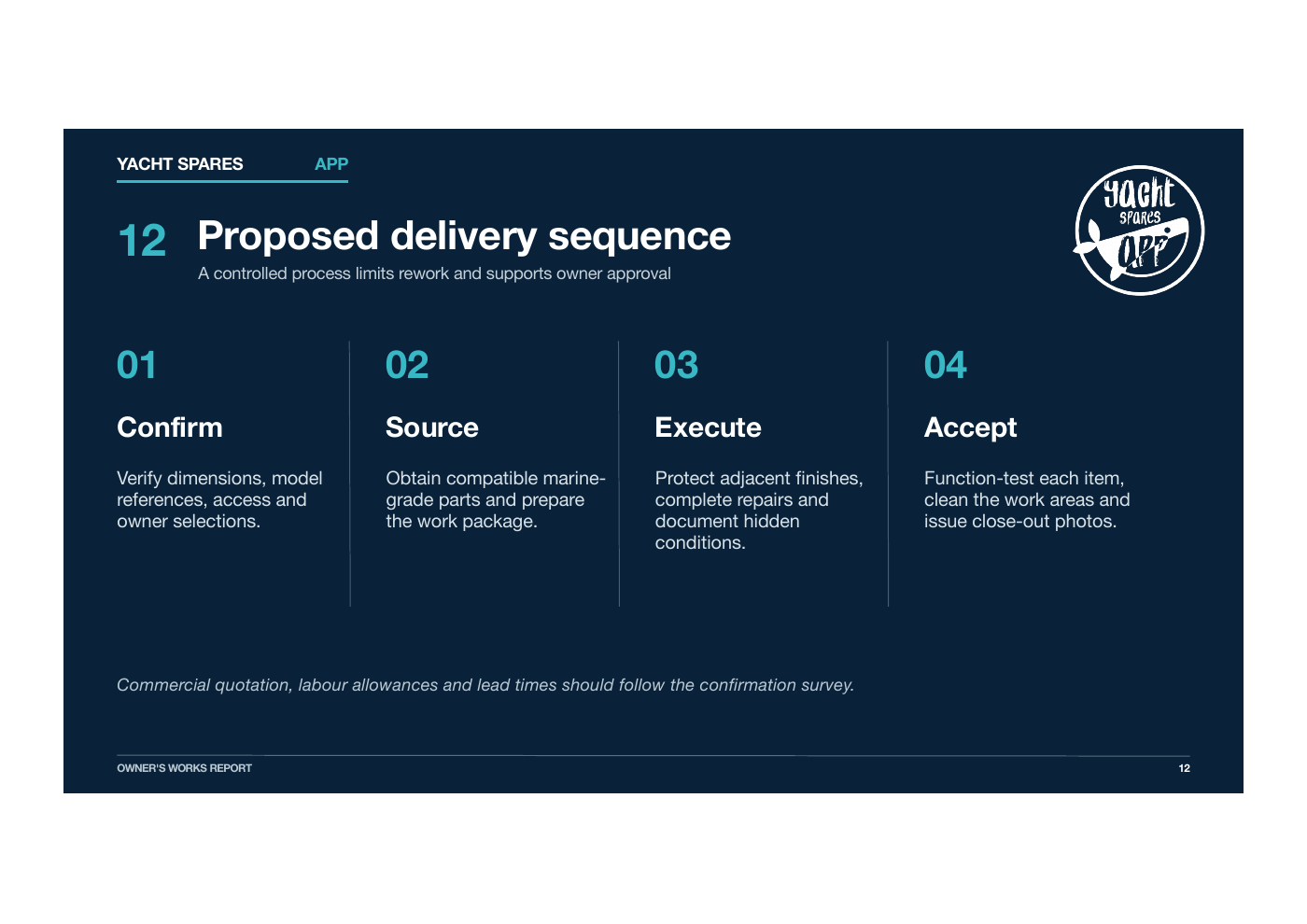
    Inspection report method: confirm, source, execute and accept
    The proposed method, from initial verification to work acceptance.

    Final costs, lead times and work order should be set only after onboard checks and owner approval. This prevents a working assumption from being presented as a certainty.

    What owners and management gain

    A strong inspection report brings localised photographs, priorities, technical checks, repair scope and expected tests into one document. It supports clear exchanges between crew, management, suppliers and contractors, while recording decisions.

    The same thinking informs Yacht Spares APP: connecting needs identified on board with the right references and a shared action trail.

    Anonymised case study. Images are extracts from a visit report prepared by Yacht Spares APP. Recommendations reflect findings on the inspection date; this article is neither a complete diagnosis nor evidence that the work has been completed.

  • Yacht Spare Parts Lead Times: Plan Beyond the Supplier Quote

    For a moving yacht, a supplier’s lead time is only one part of the delivery plan. The useful date is when the correct part can be checked and available to the crew.

    Separate the clocks

    A quote can say “available in five days” while leaving important questions unanswered. Is the part on a supplier’s shelf, waiting for a manufacturer or still subject to confirmation? When can it be dispatched? How long will transport take to the intended port? And when can the yacht actually receive it?

    Record these dates separately. A realistic plan includes stock confirmation, dispatch, transit, customs or local handling where relevant, and the yacht’s own schedule. It also names the person who will confirm each step.

    Check the destination early

    The most convenient address is not always the most reliable delivery point. A yacht may leave before a parcel arrives, a marina may have limited receiving hours, or a local agent may need advance notice. Confirm the receiving contact, delivery instructions and a fallback address before placing the order.

    For a part needed during a voyage, build a decision date: the last day on which the original delivery plan remains useful. If that date passes without confirmation, the crew can consider another port, an alternative supplier or a temporary operational plan.

    Make uncertainty visible

    Use simple status labels such as reference to verify, stock confirmed, ordered, dispatched, received and checked on board. A parcel marked “delivered” by a carrier is not necessarily in the engineer’s hands or ready for installation.

    Keep the part reference, purchase order, tracking number, receiving contact and latest ETA together. When an ETA changes, record the new source and time of the update. That makes handovers easier and prevents an old assumption from circulating as a fact.

    Close the loop

    When the part arrives, verify its condition and reference against the original request. Record where it went: installed, returned, or placed into stock. The delivery plan is only complete once the crew can use the part.

    Good lead-time management does not eliminate delays. It gives the team enough information to respond before a delay becomes a surprise.

  • Why Spare-Parts Planning Matters on Board

    A small amount of structured planning can make maintenance work more predictable without filling every locker with stock.


    Every yacht has limited storage, a changing itinerary and equipment with different consequences when it fails. Spare-parts planning is the exercise of balancing those realities. The aim is not to buy everything in advance; it is to understand which gaps would be costly or difficult to close at the wrong moment.


    Separate critical from routine


    Start with the systems that keep the yacht safe, operational and comfortable. Ask what happens if a part fails, whether the equipment has redundancy and how quickly a replacement could realistically reach the vessel. A small, inexpensive item can be critical if it disables a larger system. A costly component may be less urgent if a verified alternative or repair route is available.


    For each item, note its expected use, shelf life, storage needs and the evidence for the selected quantity. This keeps “critical stock” from turning into an unexamined collection of old parts.


    Use the itinerary as a planning tool


    Before a long passage, a busy charter period or a change of cruising region, review open maintenance work and upcoming service intervals. Cross-check parts against lead times and the practicalities of delivery at future ports. A supplier’s advertised availability is only one part of the journey; customs, local agents and receiving arrangements can affect the final handover.


    Ordering earlier does not eliminate every problem, but it creates room to verify references and discuss alternatives before urgency narrows the options.


    Keep the inventory trustworthy


    An inventory is useful only when the crew can find what it says is on board. Give each part a clear description and storage location. Log consumption when a part is used, not weeks later. Periodically check quantities and condition, especially for items sensitive to age, moisture or temperature.


    A useful review rhythm


    Review critical items before major movements, check upcoming maintenance at regular crew meetings, and reconcile physical stock after busy service periods.


    Make ownership clear


    Someone needs to confirm a requirement, someone needs to approve a purchase, and someone needs to receive and record the part. Those responsibilities can sit with different people, but the handoffs should be visible. A shared record reduces duplicate orders and prevents an urgent request from disappearing between messages.


    Good planning leaves the crew with fewer surprises and better choices when something does go wrong.


  • A Practical Pre-Season Spares Check

    A focused review before the season can reveal missing stock, outdated references and delivery constraints while there is still time to act.


    Pre-season preparation is often a race between maintenance, crew changes and the first firm dates on the calendar. A spare-parts check is most useful when it produces a short list of decisions and orders, not a large document that nobody revisits.


    Begin with planned work


    List the services, inspections and known defects expected before and during the season. For each task, verify the required parts against the correct equipment model and current manual. Confirm whether the item is already on board and whether the stored quantity is still usable.


    Pay attention to consumables, seals and components with expiry dates or storage requirements. A label in the inventory does not prove that a part is present or in suitable condition.


    Review the systems that matter most


    Walk through the yacht system by system with the people responsible for it. Ask what has caused disruption before, what has a long lead time and what cannot easily be sourced on the planned itinerary. Consider redundancy and the availability of a safe, approved alternative. This conversation is more valuable than applying the same stock rule to every yacht.


    Check the receiving route


    For anything that must be ordered, note the final delivery location, local agent, receiving contact and latest useful arrival date. Confirm how packages will be identified and who will check them on arrival. When the yacht is moving frequently, a good parts plan includes a realistic route to the vessel.


    Pre-season review list

    • Upcoming service tasks and known defects
    • Critical stock and physical quantities
    • Part numbers, compatibility and shelf life
    • Open orders, lead times and delivery contacts
    • Owner for each unresolved action

    Finish with actions, not assumptions


    Give each gap an owner and a date for the next check. Separate items that need an immediate order from those needing technical verification. Once a delivery is received, reconcile it with the request and update the inventory.


    A pre-season check cannot predict every failure. It can make the predictable work visible early enough for the crew to respond calmly and accurately.