
Author: OXC

  • Yacht inspection: turning onboard findings into an action plan

    Yacht inspection: turning onboard findings into an action plan

    A blocked drain, a deteriorating seat support, a fitting that no longer closes properly: small onboard defects deserve more than a loose repair list. During targeted visits for owners and yacht management teams, I photograph findings, identify what still needs checking and turn observations into a prioritised work report.

    This anonymised example comes from a real visit. The report covered nine work packages, from essential functions to guest comfort. The three extracts below show observations and recommendations, not completed repairs.

    Why carry out a targeted onboard inspection?

    It complements the crew’s daily monitoring by bringing scattered issues into one clear view. What affects the yacht’s use? What may worsen if left unattended? What can be scheduled? The owner and management then have a practical document for decisions, quotations and follow-up.

    Priorities remain provisional until access, equipment references and compatible parts have been confirmed. A useful report separates what was observed, what is proposed and what still needs verification.

    Example 1: a blocked locker drain

    Water was not draining properly from a port-side locker. The visible mark alone does not define the repair. The drain route, hose, fittings and outlet must be checked to find the obstruction. After addressing the cause, a documented flow test should confirm the result.
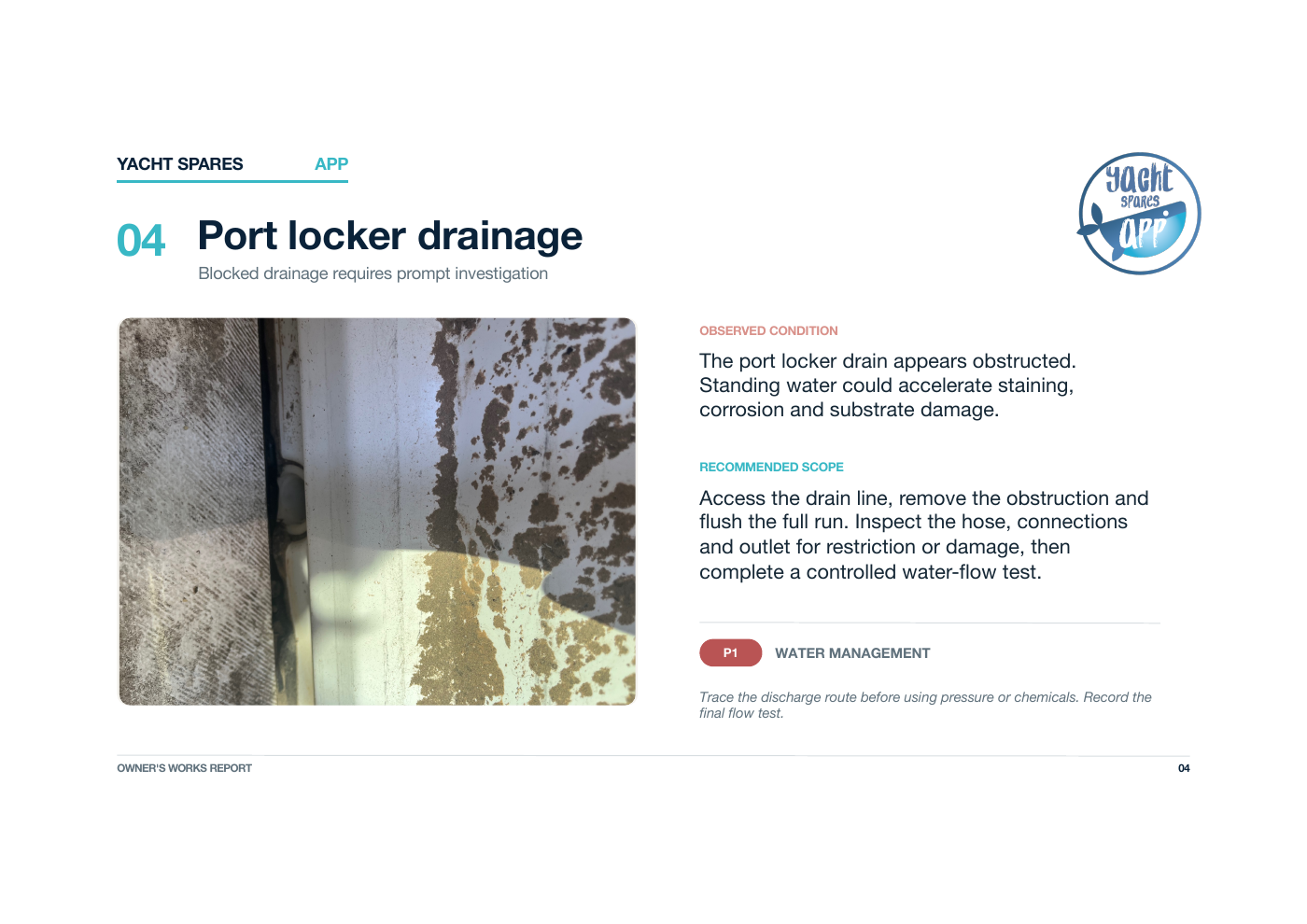
    Inspection report extract showing a blocked port-side locker drain
    Report extract: photographic finding, proposed intervention and drainage check.

    Example 2: repairing a seat and its support

    A torn cover can conceal a deeper problem. Here, moisture had also damaged the wooden support. Replacing the upholstery alone could leave the cause untouched. The proposed scope includes finding the water ingress, removing the seat, making a protected marine-grade support and restoring the upholstery after approval of the material and colour.
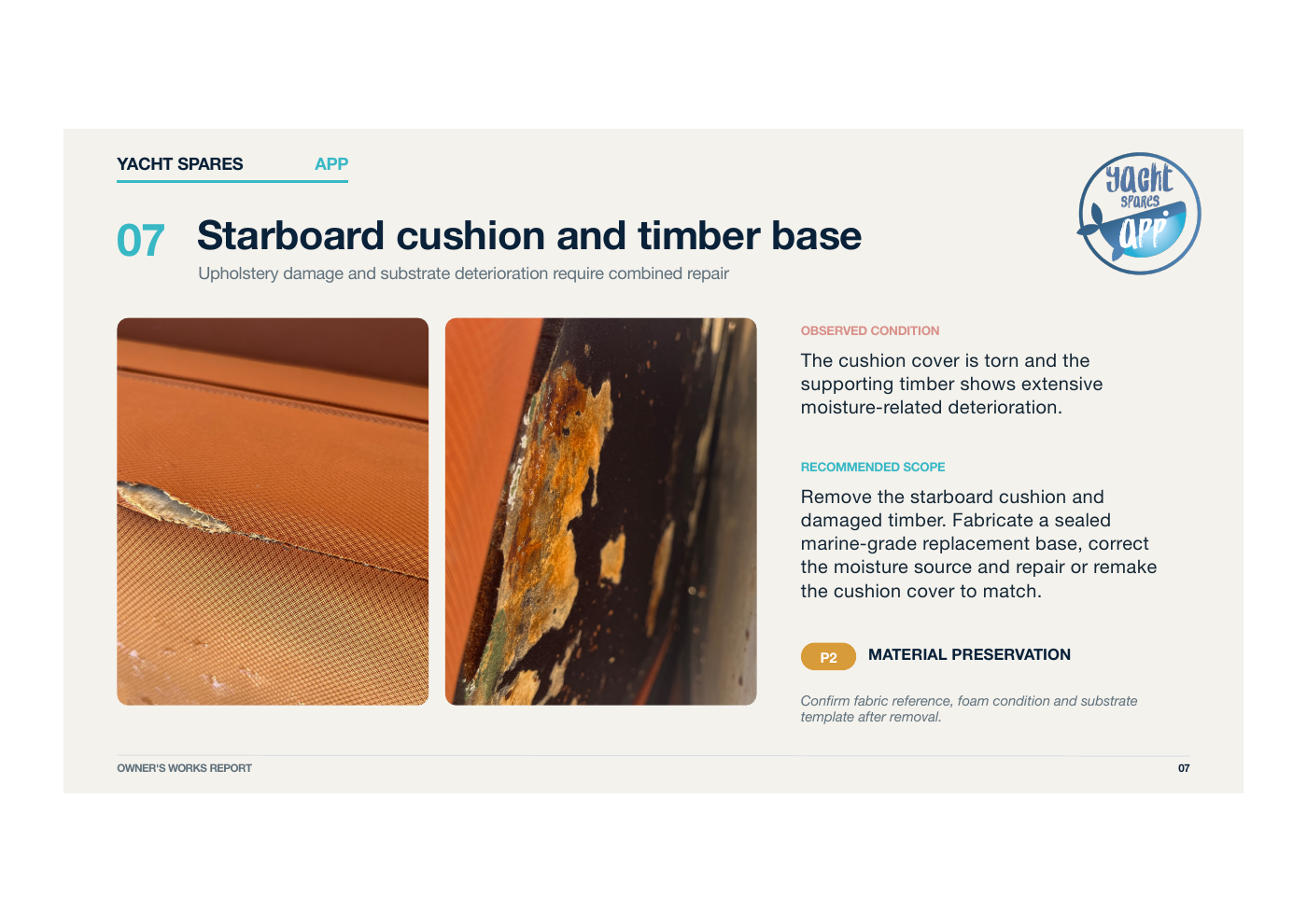
    Inspection report extract showing torn seating and damaged timber support
    The condition of both the seat and its support is recorded before the repair is defined.

    From finding to acceptance

    The report goes beyond photographs and proposes a sequence that reduces ordering mistakes and rework:

    • Confirm: measure, identify models, check access and agree the owner’s choices.
    • Source: identify compatible parts and prepare the work package.
    • Execute: protect adjacent finishes, carry out the work and document what is found after dismantling.
    • Accept: test each function, clean the area and provide closing photographs.
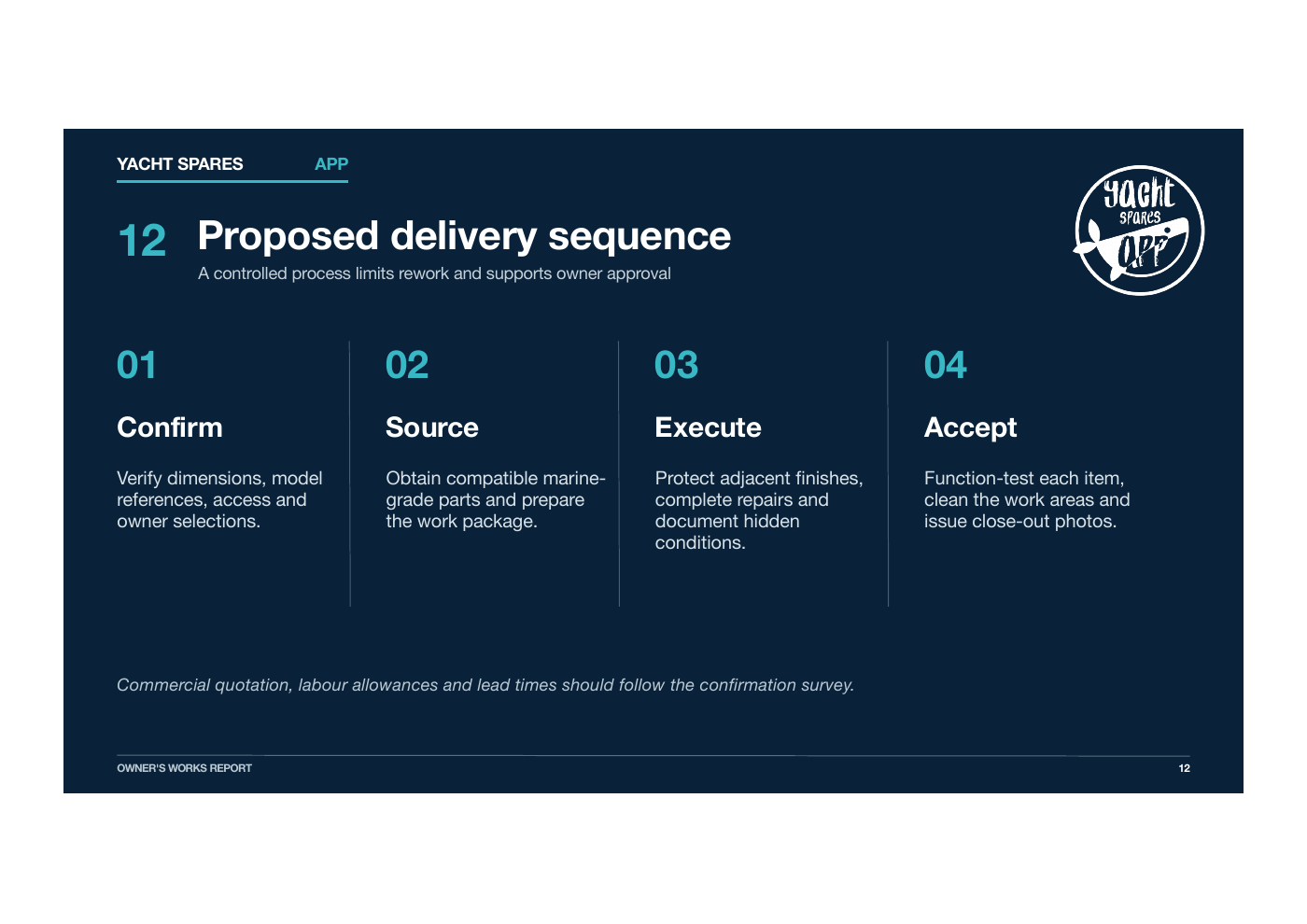
    Inspection report method: confirm, source, execute and accept
    The proposed method, from initial verification to work acceptance.

    Final costs, lead times and work order should be set only after onboard checks and owner approval. This prevents a working assumption from being presented as a certainty.

    What owners and management gain

    A strong inspection report brings localised photographs, priorities, technical checks, repair scope and expected tests into one document. It supports clear exchanges between crew, management, suppliers and contractors, while recording decisions.

    The same thinking informs Yacht Spares APP: connecting needs identified on board with the right references and a shared action trail.

    Anonymised case study. Images are extracts from a visit report prepared by Yacht Spares APP. Recommendations reflect findings on the inspection date; this article is neither a complete diagnosis nor evidence that the work has been completed.

  • How to Compare Yacht Spare Parts Quotations

    Two quotations for a yacht spare part can look similar while covering very different requirements. Compare the evidence and the delivery plan before comparing the price.

    Confirm what is being quoted

    Begin with the exact manufacturer, part reference and revision or supersession where relevant. Check quantity, unit of measure and whether the quote is for an original part, an approved equivalent or a proposed alternative. A description that merely resembles the request is not enough to confirm compatibility.

    Ask the supplier to flag any assumption. If the equipment serial number, voltage, dimensions or material were not checked, make that visible before the order is placed.

    Compare the total path to the yacht

    A lower item price can be offset by shipping, handling or a longer delay. Record availability, dispatch date, transport method and expected arrival separately. For a moving yacht, confirm the receiving port and contact before treating the ETA as reliable.

    Where customs or local agency support is involved, identify who handles it. A part delivered to the wrong desk at the right marina still creates work for the crew.

    Keep a small comparison record

    • Confirmed part reference and evidence of compatibility
    • Availability, dispatch and expected receipt dates
    • Item price, transport and other known costs
    • Warranty, returns and conditions for alternatives
    • Open questions and the person responsible for resolving them

    This record does not need to become a complicated procurement document. A concise comparison helps the captain or manager understand what is being approved and lets the engineer check technical suitability.

    Carry the decision forward

    Once a supplier is chosen, keep the final approved specification with the order. If the supplier proposes a substitution after approval, reopen the technical check. When the part arrives, compare it with the approved reference and update the yacht’s records.

    A good quotation is useful because it reduces uncertainty, not because it fits neatly in an inbox.

  • A Better Handover for Yacht Purchasing Teams

    A yacht purchase often moves between the engineer, captain, shore team, supplier and receiving agent. A clear handover keeps the requirement intact as it moves.

    Put the request in one place

    When a request begins in a message, continues in a spreadsheet and finishes in someone’s inbox, each person sees a different version. Start with one record that contains the equipment, part reference, quantity, reason for the request, required date and delivery point. Attach photographs and manual references where they resolve ambiguity.

    Give the request an owner and a status. The owner does not have to do every step, but should know what is waiting for verification, approval, ordering or receipt.

    Define the decision points

    Before asking suppliers to quote, decide which technical details the engineer must confirm. Before placing the order, identify who checks compatibility, cost and timing. If an alternative is offered, capture why it is acceptable and who approved it.

    These checkpoints protect the intent of the original request. They are especially useful when a team changes watch, the yacht moves between ports or a purchase continues while a key person is off duty.

    Write updates for the next person

    A useful handover note answers three questions: what has been confirmed, what is still uncertain and what happens next? Include the latest ETA, the source of that ETA, the next follow-up date and the contact for the receiving port.

    A short factual update is better than a long thread. “Supplier confirms part number X in stock; dispatch expected Thursday; agent details still to confirm” tells the next person exactly where to pick up the work.

    Finish with receipt and records

    Receiving is a technical step, not just an administrative one. Compare the delivered reference with the request, check condition and quantity, then record whether the item was installed or placed into stock. Store the final supplier reference so the next purchase starts from verified information.

    A shared workflow makes it easier to see the whole path from need to usable part. It also leaves a trail that helps the crew learn from each purchase.

  • Yacht Spare Parts Lead Times: Plan Beyond the Supplier Quote

    For a moving yacht, a supplier’s lead time is only one part of the delivery plan. The useful date is when the correct part can be checked and available to the crew.

    Separate the clocks

    A quote can say “available in five days” while leaving important questions unanswered. Is the part on a supplier’s shelf, waiting for a manufacturer or still subject to confirmation? When can it be dispatched? How long will transport take to the intended port? And when can the yacht actually receive it?

    Record these dates separately. A realistic plan includes stock confirmation, dispatch, transit, customs or local handling where relevant, and the yacht’s own schedule. It also names the person who will confirm each step.

    Check the destination early

    The most convenient address is not always the most reliable delivery point. A yacht may leave before a parcel arrives, a marina may have limited receiving hours, or a local agent may need advance notice. Confirm the receiving contact, delivery instructions and a fallback address before placing the order.

    For a part needed during a voyage, build a decision date: the last day on which the original delivery plan remains useful. If that date passes without confirmation, the crew can consider another port, an alternative supplier or a temporary operational plan.

    Make uncertainty visible

    Use simple status labels such as reference to verify, stock confirmed, ordered, dispatched, received and checked on board. A parcel marked “delivered” by a carrier is not necessarily in the engineer’s hands or ready for installation.

    Keep the part reference, purchase order, tracking number, receiving contact and latest ETA together. When an ETA changes, record the new source and time of the update. That makes handovers easier and prevents an old assumption from circulating as a fact.

    Close the loop

    When the part arrives, verify its condition and reference against the original request. Record where it went: installed, returned, or placed into stock. The delivery plan is only complete once the crew can use the part.

    Good lead-time management does not eliminate delays. It gives the team enough information to respond before a delay becomes a surprise.

  • How to Build a Critical Yacht Spares List

    A useful critical spares list is a decision tool. It connects the equipment that matters, the parts that can fail and the time available to respond.

    Start with consequences, not a catalogue

    Many yachts have shelves full of parts but still discover a gap when an important system stops. A critical list should begin with the systems whose failure would affect safety, essential operation or the planned voyage. The engineer and captain can then agree which components deserve a place on board and which can be sourced when needed.

    Separate criticality from frequency. A filter changed every month is predictable and easy to plan. A small electronic module may rarely fail, yet leave a key system unavailable for weeks if its replacement has a long lead time.

    Score each part with four questions

    1. Impact: What stops or becomes unsafe if this item fails?
    2. Likelihood: What do service history and manufacturer guidance suggest?
    3. Lead time: How quickly can the exact part reach the yacht in its normal cruising area?
    4. Alternatives: Is there a tested substitute, repair path or redundant system?

    These questions make the list easier to defend and update. They also expose uncertainty: a part number that has not been checked against the installed equipment is not yet a dependable spare.

    Record enough detail to act

    For each critical item, keep the equipment make, model and serial number, the confirmed part reference, quantity held, storage location, last verification date and preferred supplier. Add photographs or a manual reference where they help distinguish similar parts. Note shelf life and storage conditions for items that can deteriorate.

    Set a minimum quantity only after considering the yacht’s route, service schedule and realistic replenishment time. One spare may be enough in a home port and insufficient during a remote season.

    Keep the list alive

    Review the list after major maintenance, equipment replacement, a difficult order or a change in itinerary. Reconcile it with physical stock before the season. Assign an owner to every unresolved reference or stock gap, then make the next check date visible.

    The goal is a short, trusted list that helps the crew act quickly—not another spreadsheet that nobody wants to open.

  • Finding the Right Yacht Spare Part

    A practical way to turn an uncertain part request into a clear specification, a useful supplier conversation and a traceable delivery.


    A spare-parts request often starts with a simple sentence: “We need another one of these.” The difficult part is making sure everyone means the same component. A clear request protects the crew’s time and helps a supplier respond with a part that actually fits the equipment on board.


    Start with the equipment, not the part name


    Record the equipment manufacturer, model and serial number. Photograph the identification plate and the installed component from several angles. If the part has its own number or marking, capture that too. A brief note about the fault, location and function helps distinguish similar-looking components.


    Check the manual and the vessel’s maintenance records before searching a catalogue. A previously purchased item may have been superseded, and the part currently fitted may differ from the original specification.


    Describe the requirement precisely


    A useful request combines the exact part reference, the equipment it serves, the required quantity and the date it is needed. Add dimensions, material, voltage, pressure rating or other technical characteristics when relevant. Mark what is confirmed and what still needs verification; uncertainty hidden in a request tends to reappear later as a wrong delivery.


    If an alternative part is proposed, ask for the manufacturer’s compatibility evidence or a clear technical comparison. A substitute should be evaluated against the application, not accepted simply because it looks similar or can ship sooner.


    Make delivery part of the specification


    The yacht’s position and schedule matter as much as the item itself. State the delivery port or agent, any receiving hours, the vessel’s next movement and the preferred contact on board. For urgent orders, confirm stock availability and dispatch timing separately from the quoted transit time.


    A compact request checklist

    • Equipment make, model and serial number
    • Part reference, photos and technical details
    • Quantity, urgency and acceptable alternatives
    • Delivery point, receiving contact and schedule

    Close the loop on board


    When the part arrives, verify its reference and condition before signing the request off. Record where it is stored or installed, and add the final supplier reference to the yacht’s records. The next request will be faster because the information is already there.


    The goal is not more paperwork. It is a shared, reliable description of what the yacht needs, from the first photograph to the final receipt.


  • Why Spare-Parts Planning Matters on Board

    A small amount of structured planning can make maintenance work more predictable without filling every locker with stock.


    Every yacht has limited storage, a changing itinerary and equipment with different consequences when it fails. Spare-parts planning is the exercise of balancing those realities. The aim is not to buy everything in advance; it is to understand which gaps would be costly or difficult to close at the wrong moment.


    Separate critical from routine


    Start with the systems that keep the yacht safe, operational and comfortable. Ask what happens if a part fails, whether the equipment has redundancy and how quickly a replacement could realistically reach the vessel. A small, inexpensive item can be critical if it disables a larger system. A costly component may be less urgent if a verified alternative or repair route is available.


    For each item, note its expected use, shelf life, storage needs and the evidence for the selected quantity. This keeps “critical stock” from turning into an unexamined collection of old parts.


    Use the itinerary as a planning tool


    Before a long passage, a busy charter period or a change of cruising region, review open maintenance work and upcoming service intervals. Cross-check parts against lead times and the practicalities of delivery at future ports. A supplier’s advertised availability is only one part of the journey; customs, local agents and receiving arrangements can affect the final handover.


    Ordering earlier does not eliminate every problem, but it creates room to verify references and discuss alternatives before urgency narrows the options.


    Keep the inventory trustworthy


    An inventory is useful only when the crew can find what it says is on board. Give each part a clear description and storage location. Log consumption when a part is used, not weeks later. Periodically check quantities and condition, especially for items sensitive to age, moisture or temperature.


    A useful review rhythm


    Review critical items before major movements, check upcoming maintenance at regular crew meetings, and reconcile physical stock after busy service periods.


    Make ownership clear


    Someone needs to confirm a requirement, someone needs to approve a purchase, and someone needs to receive and record the part. Those responsibilities can sit with different people, but the handoffs should be visible. A shared record reduces duplicate orders and prevents an urgent request from disappearing between messages.


    Good planning leaves the crew with fewer surprises and better choices when something does go wrong.


  • From Spreadsheets to Shared Workflows

    The real value of a digital procurement process is a clear handoff: what is needed, who is acting and what happens next.


    A spreadsheet can be a good starting point for yacht inventory. Problems appear when the purchase request lives in one file, technical details in a message, the quotation in an inbox and the delivery update with another person. Each source may be accurate on its own, yet the crew still has to reconstruct the full story.


    Give each request one home


    A useful workflow begins with a single record for the requirement. It should capture the equipment, part identification, quantity, urgency and the person who raised it. Supporting photographs and documents belong with that record. The point is not to force every decision into a rigid form; it is to preserve the context needed by the next person.


    When a request changes, update the same record. Otherwise, an old quotation may be compared with a new specification without anyone noticing.


    Show the decision, not just the status


    “Ordered” is helpful, but it does not explain why one option was chosen over another. Keep the quotation, the accepted reference, the approval and any compatibility notes together. If a substitute is selected, record who checked it and against which equipment details. These small notes become valuable when the same need returns months later.


    Follow the part to the yacht


    A request is not finished when a purchase order is issued. The crew also needs to know whether an item has shipped, where it is going, who can receive it and whether it arrived in the expected condition. A clear handoff from supplier to agent to vessel prevents a delivery update from being mistaken for a completed job.


    Four questions a shared workflow should answer


    What exactly is required?
    Who is responsible for the next step?
    Which option was approved, and why?
    Has the correct item reached the yacht?


    Keep the tool proportionate to the work


    Technology helps when it removes duplicate entry and makes information easier to find. It becomes a burden when it asks the crew to maintain several versions of the same truth. This is the practical problem that makes digital tools, including Yacht Spares APP, relevant to yacht spare-parts work.


    Whatever system a yacht chooses, start by making the responsibilities and information flow clear. The software should support that process, not define it in isolation.


  • A Practical Pre-Season Spares Check

    A focused review before the season can reveal missing stock, outdated references and delivery constraints while there is still time to act.


    Pre-season preparation is often a race between maintenance, crew changes and the first firm dates on the calendar. A spare-parts check is most useful when it produces a short list of decisions and orders, not a large document that nobody revisits.


    Begin with planned work


    List the services, inspections and known defects expected before and during the season. For each task, verify the required parts against the correct equipment model and current manual. Confirm whether the item is already on board and whether the stored quantity is still usable.


    Pay attention to consumables, seals and components with expiry dates or storage requirements. A label in the inventory does not prove that a part is present or in suitable condition.


    Review the systems that matter most


    Walk through the yacht system by system with the people responsible for it. Ask what has caused disruption before, what has a long lead time and what cannot easily be sourced on the planned itinerary. Consider redundancy and the availability of a safe, approved alternative. This conversation is more valuable than applying the same stock rule to every yacht.


    Check the receiving route


    For anything that must be ordered, note the final delivery location, local agent, receiving contact and latest useful arrival date. Confirm how packages will be identified and who will check them on arrival. When the yacht is moving frequently, a good parts plan includes a realistic route to the vessel.


    Pre-season review list

    • Upcoming service tasks and known defects
    • Critical stock and physical quantities
    • Part numbers, compatibility and shelf life
    • Open orders, lead times and delivery contacts
    • Owner for each unresolved action

    Finish with actions, not assumptions


    Give each gap an owner and a date for the next check. Separate items that need an immediate order from those needing technical verification. Once a delivery is received, reconcile it with the request and update the inventory.


    A pre-season check cannot predict every failure. It can make the predictable work visible early enough for the crew to respond calmly and accurately.